

Call
Appt
Hours
Scleral Lenses in Pittsburgh
A bad experience with contact lenses doesn’t necessarily mean contacts aren’t an option for you. If you’ve tried contact lenses before and found them uncomfortable, difficult to wear, or unable to give you the vision clarity you need, you may just need a different type of contact lens.
At Pittsburgh Primary Eyecare, our specialty contact lens specialist, Dr. Bressler, offers scleral lenses in Pittsburgh for patients whose eyes require a more customized approach.
What are scleral lenses?
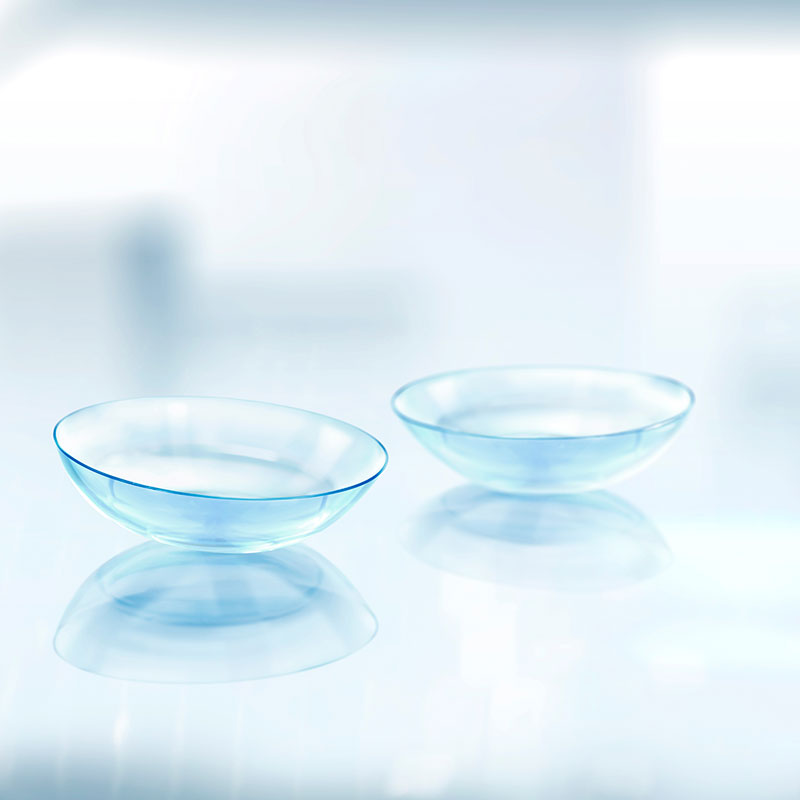
Unlike the soft contact lenses most people are used to, scleral lenses are large-diameter, rigid gas-permeable lenses that rest on the white part of the eye (known as the sclera) rather than directly on the cornea.¹ This design creates a small gap between the lens and the corneal surface that is filled with saline solution, providing continuous moisture and a smooth optical surface regardless of the shape or condition of the cornea underneath.
Because they vault over the cornea entirely, scleral lenses can provide exceptional comfort and clarity for patients whose eyes don’t respond well to conventional lenses. They also stay securely in place. The upper and lower edges of scleral lenses sit underneath your eyelids, so there’s very little risk of them falling out or something getting underneath them.
Who can benefit from scleral lenses?
Scleral lenses are considered specialty contact lenses because they’re designed to address a range of conditions that standard soft lenses can’t manage effectively. They may be a good fit if you have any of the following:
Keratoconus
Keratoconus causes the cornea to progressively thin and take on a cone-like shape, which makes achieving clear, stable vision with soft lenses or glasses increasingly difficult. Scleral lenses vault over the irregular corneal surface and create a smooth optical surface, which often results in a significant improvement in vision quality and comfort.
Dry eye
Scleral lenses can provide significant relief for patients with chronic dry eye, especially when eye drops aren’t enough on their own. Before placing scleral lenses in your eyes, you fill them with saline solution, which stays on the lens and moisturizes your eyes throughout the day.² Many of our dry eye patients find they rely far less on artificial tears after making the switch.
Irregular corneas
An irregular corneal surface caused by scarring, injury, or changes after surgery can make traditional contact lenses uncomfortable or unable to provide clear vision. Scleral lenses vault over these irregularities to create a smoother optical surface, helping improve both comfort and visual clarity.
High or complex refractive errors
Some prescriptions can be difficult to fully correct with traditional soft contact lenses. Scleral lenses can provide clearer, more stable vision for patients with more complex refractive errors, and many patients report sharper vision than they achieved with soft lenses or glasses.
Post-surgical eyes
Patients who have undergone LASIK, corneal transplants, or other eye procedures sometimes find that their corneas no longer tolerate standard contact lenses comfortably. Scleral lenses can often restore both comfort and visual clarity in these situations.
Severe ocular surface conditions
Conditions such as Stevens-Johnson syndrome, graft-versus-host disease, and various forms of keratitis can cause significant changes to the ocular surface. Scleral lenses offer a level of protection and sustained moisture that standard lenses are not able to provide.
Schedule your specialty contact lens exam in Pittsburgh
Are you wondering if scleral lenses are the right fit for your eyes? A specialty contact lens exam at Pittsburgh Primary Eye Care gives us the detailed information we need to determine whether scleral lenses are appropriate for your eyes and, if so, how to fit them for the best possible outcome.
Give us a call or schedule your appointment online today.

Dr. Herbert C. Bressler
Specialty Contact Lens Specialist
Frequently asked questions about scleral lenses
What makes scleral lenses different from standard contact lenses?
The most significant difference is in size and design. Standard soft lenses rest on and around the cornea, while scleral lenses are larger, extend beyond the cornea, and cover parts of the surrounding sclera.
Scleral lenses are rigid and hold their shape, but oxygen can still pass through them. They also maintain a reservoir of fluid between the back of the lens and the front of your cornea, which makes them a better option for patients with dry eye or irregular corneal surfaces.
How do I insert and remove scleral lenses?
Inserting scleral lenses is different from what most contact lens wearers are used to, but it’s very learnable. You fill the lens bowl with saline, tilt your head forward, and bring the lens to your eye while keeping it level. The technique is mostly about keeping the fluid in the lens as it sits against your eye.
To remove the lens, you will use a small suction tool. Before you leave your fitting appointment, we’ll make sure you’re comfortable with the entire process from start to finish.
How long do scleral lenses last?
With proper care, scleral lenses typically last up to three years. That lifespan can vary depending on the lens material, how well they’re cared for, and whether your prescription or corneal shape changes over time. We also recommend regular follow-up visits to make sure your lenses continue to fit well and that your eyes remain healthy over time.



